
Federal Employees Retirement System (FERS)
Congress created the Federal Employees Retirement System (FERS) in 1986, and it became effective on January 1, 1987. Since then, new Federal civilian employees who have retirement coverage are covered by FERS.
FERS is a retirement plan that provides benefits from three different sources:
1. Basic Benefit Plan
2. Social Security
3. Thrift Savings Plan (TSP)
Two of the three parts of FERS (Social Security and the TSP) can go with you to your next job if you leave the Federal Government before retirement. The Basic Benefit and Social Security parts of FERS require you to pay your share each pay period. Your agency withholds the cost of the Basic Benefit and Social Security from your pay as payroll deductions. Your agency pays its part too. Then, after you retire, you receive annuity payments each month for the rest of your life.
Eligibility
There are four categories of benefits in the Federal Employees Retirement System (FERS) Basic Benefit Plan:
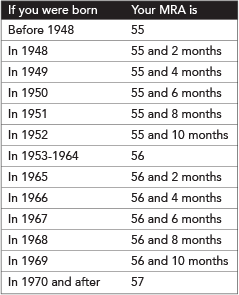
Eligibility is determined by your age and number of years of creditable service. In certain situations, you must reach the Minimum Retirement Age (MRA) to receive retirement benefits. Use the chart below to figure your Minimum Retirement Age.
Immediate Retirement
An immediate retirement benefit is one that starts within 30 days from the date you stop working.
If you meet one of the following sets of age and service requirements, you are entitled to an immediate retirement benefit:
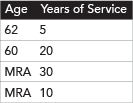
If you retire at the MRA with at least 10, but less than 30 years of service, your benefit will be reduced by 5 percent a year for each year you are under 62, unless you have 20 years of service and your benefit starts when you reach age 60 or later.
Early Retirement
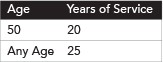
The early retirement benefit is available in certain involuntary separation cases and in cases of voluntary separations during a major reorganization or reduction in force. To be eligible, you must meet the following requirements:
Deferred Retirement
Refers to delayed payment of benefit until criteria are met, as follows:
If you leave Federal service before you meet the age and service requirements for an immediate retirement benefit, you may be eligible for deferred retirement benefits. To be eligible, you must have completed at least 5 years of creditable civilian service. You may receive benefits when you reach one of the following ages:
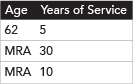
If you retire at the MRA with at least 10, but less than 30 years of service, your benefit will be reduced by 5 percent a year for each year you are under 62, unless you have 20 years of service and your benefit starts when you reach age 60 or later.
Disability Retirement
Disability Federal Employees Retirement System (FERS) Annuity Requirements:
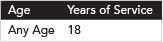
Special Requirements: You must have become disabled, while employed in a position subject to FERS, because of a disease or injury, for useful and efficient service in your current position. The disability must be expected to last at least one year. Your agency must certify that it is unable to accommodate your disabling medical condition in your present position and that it has considered you for any vacant position in the same agency at the same grade/pay level, within the same commuting area, for which you are qualified for reassignment.